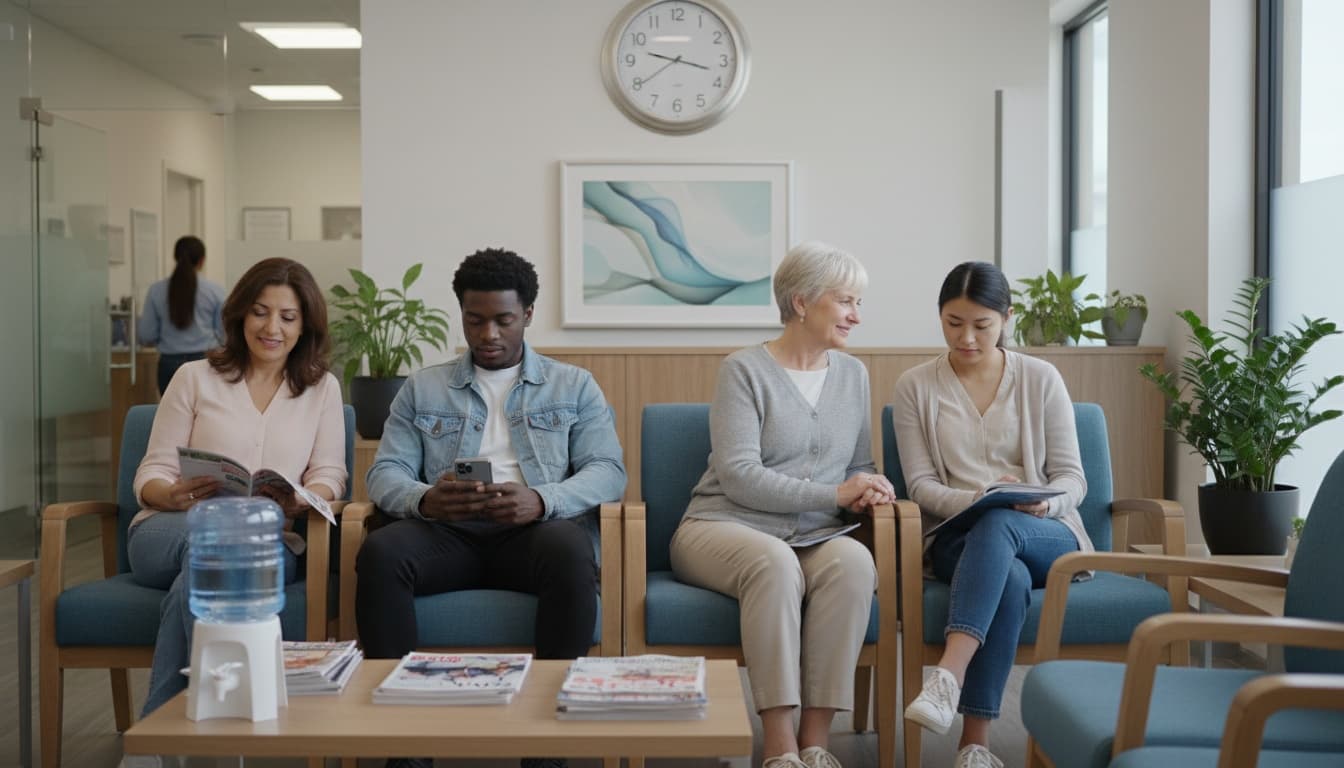
You have an appointment at 2pm and you're seen at 2:45? Discover why waiting rooms are named that way and how doctors manage their schedules.

You arrived 5 minutes early for your 2pm appointment. It's now 2:40, and you're starting to memorize the 2019 magazines in the waiting room. Why are doctors always running late?
Spoiler
It's generally not bad intentions. The medical system is designed in a way that makes delays almost inevitable.
The Impossible Math of Medical Scheduling
The 15-Minute Slot
Most doctors schedule 15-minute appointments. But in reality, an average visit lasts 18-22 minutes. This gap accumulates throughout the day.
A 15-Minute Appointment, Really?
Here's what must fit in 15 minutes:
- Greeting and settling the patient (2 min)
- Listening to symptoms and questions (5 min)
- Physical examination (3-5 min)
- Diagnosis and explanations (3 min)
- Writing prescription + paperwork (3 min)
- Patient questions (variable)
Realistic total: 18-25 minutes
The Domino Effect
8:00am - First patient
All good, doctor is on time.
9:30am - Fifth patient
Delay starts: +15 minutes.
12:00pm - Tenth patient
Delay builds: +45 minutes.
5:00pm - Last patient
Maximum delay: +1h30 possible.
The Unexpected Events That Throw Everything Off
The "I Have Another Question" Patient
"The patient comes in for a cold, then at the end: "Doctor, I've also had back pain for 3 months, some dizziness, and I wanted to show you this mole..."
"
It's human and understandable - you're at the doctor's, might as well address everything. But each "small question" adds 5-10 minutes.
Emergencies That Drop In
Daily Emergencies
A primary care doctor handles 2-3 emergencies per day on average:
- Chest pain to evaluate immediately
- Child with high fever without appointment
- Concerning test results to announce
- Patient in psychological distress
These situations can't wait and logically come before a simple prescription renewal.
The Complex Patient
Some appointments legitimately take 45 minutes:
- Announcing a serious diagnosis
- Depression or psychological issues
- Elderly patient with multiple conditions
- First visit with a new patient
Tip
If you need time (multiple issues to discuss, need to talk), mention it when booking. Some doctors offer double slots.
Why Not Just Schedule More Time?
The Doctor's Dilemma
The Impossible Equation
If the doctor schedules 30 minutes per appointment:
- They see 50% fewer patients
- Wait times for appointments go from 3 days to 6 days
- Patients complain about not getting appointments
- Income drops (fee-for-service payment)
If they keep 15 minutes:
- They see more patients
- But delays accumulate
- Patients complain about waiting
It's a system that forces doctors to choose between accessibility (seeing more patients) and punctuality.
The Economic Reality
In the US, insurance reimbursements often favor shorter visits. To maintain a viable practice, doctors must see a certain number of patients per day.
How to Reduce Your Wait Time
Get the first appointment
At 8am or 1pm (after lunch), the doctor is on time.
Avoid Monday and Friday
Busiest days with more unexpected events.
Call before leaving
Ask if the doctor is on schedule and adjust your arrival.
Prepare your visit
List your questions in advance to be efficient.
What Other Countries Do
| Country | Avg Duration | System |
|---|---|---|
| USA | 15-20 min | Variable by insurance |
| Germany | 8 min | High volume, less relational |
| Sweden | 22 min | Public system, fewer patients/day |
| UK | 10 min | NHS system |
Different healthcare systems make different trade-offs between access (short waits for appointments) and time per visit.
The Future: Solutions Are Emerging
Telehealth
For simple consultations (renewals, minor symptoms), telehealth avoids waiting room delays entirely.
Artificial Intelligence
Tools now optimize schedules based on patient history and probable visit complexity.
Medical Assistants
More and more practices employ assistants who prepare files and triage requests, making the doctor more efficient.
Conclusion
Waiting at the doctor's isn't inevitable or disrespectful - it's a symptom of a healthcare system under pressure.
Between wanting to see all patients who need care and the impossibility of predicting exact consultation length, doctors do their best with real constraints.
Good News
Things are evolving: telehealth, medical assistants, smart scheduling tools... Future waiting rooms may be less crowded.
In the meantime, arm yourself with patience, a good book, and remember that if the doctor is running late, it's perhaps because they gave the previous patient all the attention they needed. And they'll do the same for you.
Prêt à organiser vos données médicales ?
Genki vous aide à centraliser et comprendre tous vos documents de santé, sans cloud, directement sur votre appareil.
Essayer Genki gratuitement