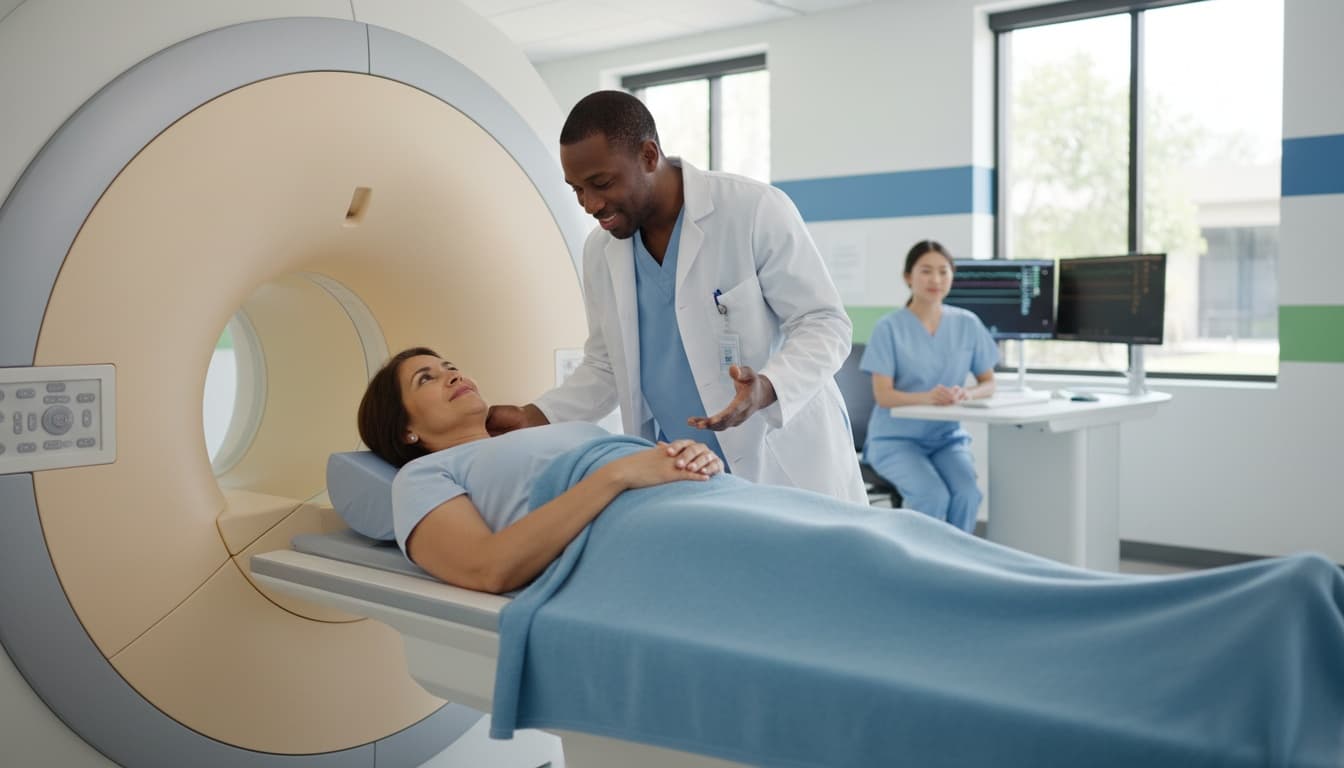
Learn how to read and understand your MRI images. This practical guide explains what doctors see and how to interpret different views.
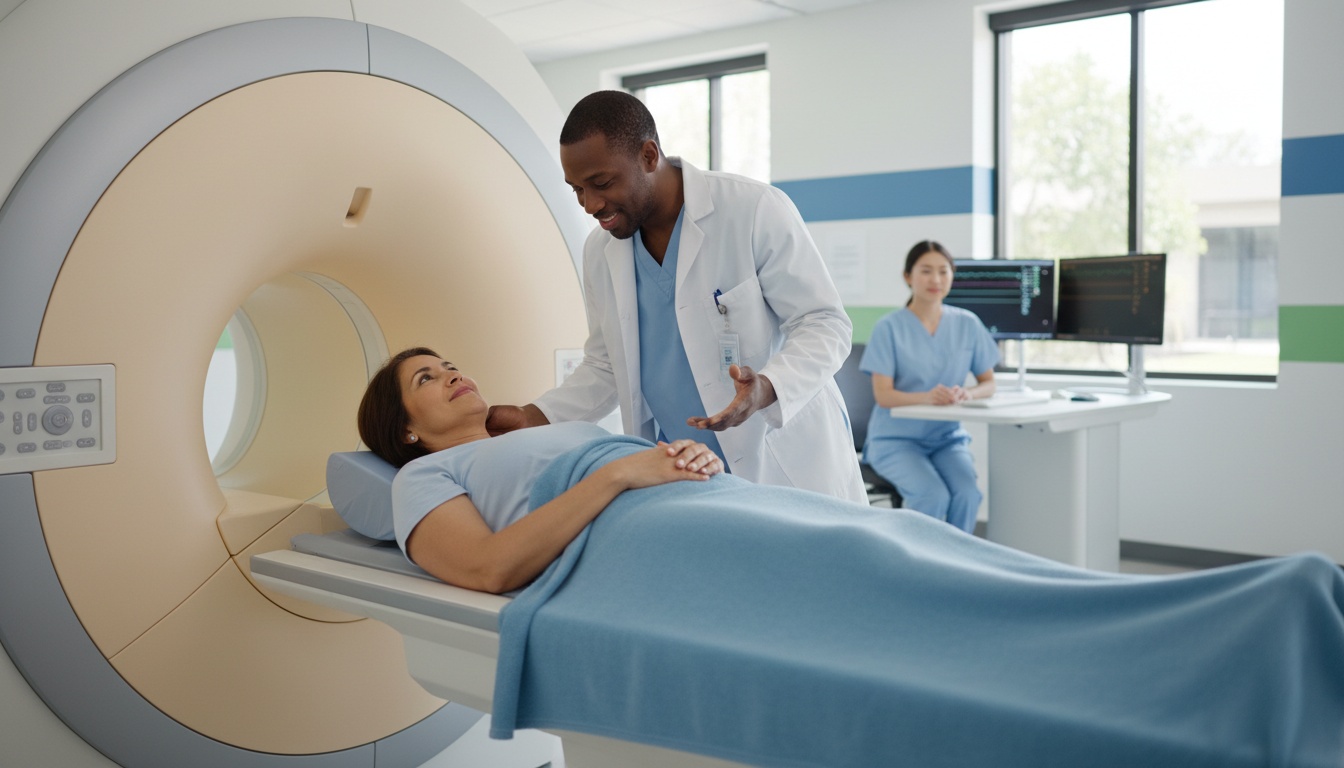
You've just received your MRI images and you're wondering what all those black and white pictures mean? This guide is here to help. Let's decode together what radiologists observe on these images.
Medical Disclaimer
This guide is educational and does not replace interpretation by a qualified radiologist. Always consult a healthcare professional for the diagnosis of your exams.
MRI Basics
MRI (Magnetic Resonance Imaging) uses magnetic fields and radio waves to create detailed images of the inside of your body. Unlike X-rays, MRI excels at visualizing soft tissues like muscles, ligaments, and the brain.
How It Works
Your body contains water, and water contains hydrogen atoms. MRI detects these atoms and creates an image based on their distribution in your tissues.
The Different MRI Sequences
Each "series" of images you see corresponds to a different sequence. Here are the main ones:
T1-Weighted
In T1, fat appears bright (white) and water appears dark (black). This is ideal for seeing normal anatomy.
T2-Weighted
In T2, it's the opposite: water appears bright. This is often helpful for highlighting fluid and inflammation, but interpretation depends on the sequence and clinical context.
Memory Trick
Think "T2 = Water is bright". The 2 looks like a swan on water!
FLAIR
FLAIR is a modified T2 sequence where the signal from "normal" water (like cerebrospinal fluid) is suppressed. Very useful for seeing brain lesions.
The Three Imaging Planes
Axial View (Transverse)
Imagine being sliced horizontally, like a loaf of bread. This is the "top to bottom" view.
Sagittal View
A side cut, dividing the body into left and right sides. Ideal for the spine.
Coronal View (Frontal)
A front-facing cut, dividing the body into front and back. Perfect for joints.
Examples by Body Region
Brain MRI
What Radiologists Look For
- White vs gray matter: should be well differentiated
- Ventricles: fluid-filled cavities, normally symmetrical
- Absence of masses: tumors, cysts, hemorrhages
- Blood vessels: assessed on specific sequences (sometimes with dedicated angiography sequences or contrast)
Spine MRI
Key Points to Observe
- Intervertebral discs: normal height, no herniation
- Spinal canal: sufficient space for the spinal cord
- Vertebrae: alignment, absence of fracture
- Spinal cord: homogeneous signal
Knee MRI
Important Structures
- Cruciate ligaments: intact, uniform black signal
- Menisci: triangular shape, no tear
- Cartilage: normal thickness, smooth surface
- Bone marrow: edema is often bright on fluid-sensitive sequences (e.g., T2 fat-sat / STIR)
Radiology Report Vocabulary
When you read your report, you might encounter these terms:
| Term | Meaning |
|---|---|
| Hyperintense | Brighter area than normal |
| Hypointense | Darker area than normal |
| Enhancement | The area picks up contrast dye |
| Edema | Swelling/inflammation (bright on T2) |
| Mass effect | Something is pushing structures |
| Unremarkable | Normal! |
"No abnormality detected" or "examination within normal limits" are the phrases you want to see in your report!
How to Use Genki for Your MRIs
With Genki, you can:
- Import your DICOM files directly from the hospital CD
- View your images with the same tools as radiologists
- Adjust contrast to better see certain structures
- Ask questions to the AI about what you're seeing
Did You Know?
Your MRI DICOM files often contain hundreds of images (called "slices"). Genki lets you scroll through them easily.
Frequently Asked Questions
Why are some areas bright?
A bright area (hyperintense) can indicate:
- Water/inflammation (on T2)
- Fat (on T1)
- Recent blood (depending on the sequence)
My MRI shows something "white" - is that serious?
Not necessarily! White can be:
- Normal fat (T1)
- Normal fluid like CSF (T2)
- An abnormality to investigate
Only your doctor can interpret this signal in your clinical context.
What's the difference with a CT scan?
| Criteria | MRI | CT Scan |
|---|---|---|
| Soft tissues | Excellent | Average |
| Bones | Average | Excellent |
| Radiation | — | |
| Duration | 20-45 min | 5-10 min |
| Claustrophobia | Possible | Rare |
Summary
T1 = anatomy
Fat bright, water dark. Ideal for seeing normal structure.
T2 = pathology
Water bright. Perfect for detecting abnormalities.
Three planes
Axial (horizontal), Sagittal (side), Coronal (front).
Ask questions
Never hesitate to ask your doctor about your results.
"An MRI image without context has little value. It's the correlation with your symptoms and medical history that enables accurate diagnosis.
"
Prêt à organiser vos données médicales ?
Genki vous aide à centraliser et comprendre tous vos documents de santé, sans cloud, directement sur votre appareil.
Essayer Genki gratuitement